Roselle
One Thousand and One NightsRoselle is the object of Tad’s romantic hopes, but the evidence that he reads as encouragement turns out to be politeness rather than love. Her story is mostly seen through Tad’s pursuit and other people’s reports: when he finally admits that she has not fallen in love with him, the case of Della and Zaen has given him a more honest way to understand what love requires.
Identity and Introduction
Roselle is known here chiefly through her place in Tad’s imagination and in the square’s social life. Tad claims that she finds him interesting, citing a recent occasion when she smiled and waved to him. He offers this as evidence while teasing Claire about her interest in studying him, and his confidence makes an ordinary greeting seem like proof of a larger attachment. The contrast matters: Roselle’s gesture is real, but Tad supplies its romantic meaning himself.
The same early exchange establishes that Roselle has her own concerns and friendships outside Tad’s account of their relationship. Claire explains that Roselle had promised to take care of Popo, lost him, and then tried to avoid Tad rather than face his questions. After Claire overhears Roselle talking with a friend, she reports that avoiding him has become a nuisance. Roselle’s silence is therefore not presented as a mysterious romantic test; it follows from an awkward, specific incident and her wish to escape Tad’s attention.
Tad’s Pursuit and Roselle’s Distance
Tad’s feelings are intense enough to shape his reading of everyday encounters. He imagines asking Roselle to marry him in an impassioned kiss scenario while complaining about the birds who intrude on him, and he later remembers her smile and wave as a sign that she finds him interesting. In both cases, the reader sees how quickly he turns a possibility into a romantic story, even though Roselle has not expressed reciprocal love.
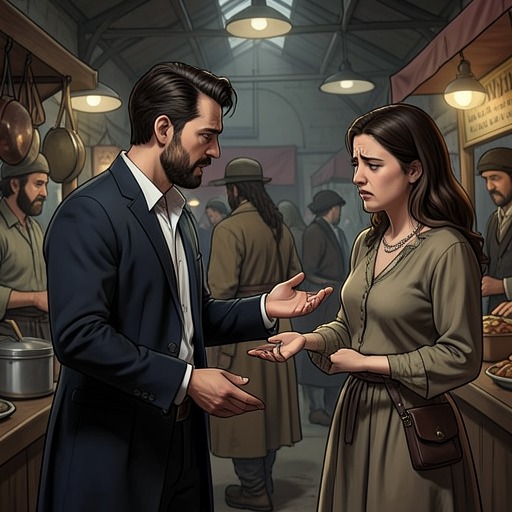
When Tad prepares to give Roselle a gift, he retrieves her necklace and sets off hoping to spend time alone with his supposed true love. Claire is making jam, and the pigeons are leaving him alone, giving Tad an unusual stretch of time to plan his approach. He searches for more than an hour through Roselle’s usual haunts before hearing her voice in the square as she leaves the dress shop. Her three companions turn to look at the display, and Tad takes the opportunity to approach with a box. Roselle freezes when she sees him. Tad bows and offers the gift, immediately regretting his haste because the eloquent speech he had planned has deserted him. The scene gives a concrete counterpart to his earlier confidence: his hopes are elaborate, but Roselle’s actual response is startled stillness.
Contrast with Della and Zaen
Roselle’s part in the story becomes clearest by comparison with Della and Zaen’s relationship. Della initially dismisses Zaen’s repeated proposals as the persistence of a suitor who began courting her when she was six and he was seven. She says that they are friendly acquaintances, not lovers, and believes he has convinced himself of an affection she has never encouraged. Their eventual reconciliation turns not on the number of his declarations, but on whether he understands and treasures the person she believes herself to be.
That outcome gives Tad a difficult lesson about Roselle. Della explains that poetry and pretty words did not show her enduring love; a personal friendship bracelet did, because its materials recalled shared memories and because it treated her as a person rather than a prize. She accepts Zaen’s proposal on the condition that he remain her dearest friend. The contrast does not establish that Roselle will eventually love Tad, or that she has the same history with him. Instead, it exposes the weakness in Tad’s assumption that longing, attention, or a seemingly warm gesture can by themselves establish reciprocity.
Change and Narrative Significance
By the end of the case, Tad admits that Roselle has not truly fallen in love with him and resolves to acknowledge that fact rather than continue treating his hope as evidence. He still intends to win her over, imagining that it may take a hundred cases or a thousand distressing nights as an agent of Lady Love. His conclusion is thus a change in understanding, not a reported change in Roselle’s feelings: he can recognize the present truth while keeping open the possibility of future effort.
Roselle’s narrative function is consequently defined as much by her absence from the romantic resolution as by her brief appearances. Tad’s hope that she will respond to him contrasts with Della’s insistence that love must recognize a person’s real self and rest on friendship. His final reflection also redirects his immediate attention toward provoking Claire and her dimples, while he continues to imagine a future with Roselle. The two impulses remain distinct. Roselle is still the woman he hopes to win, but the case has taught him that hope cannot stand in for knowledge of another person’s feelings.